Disclosure: Some links on this page are affiliate links. If you buy through them, we may earn a small commission at no extra cost to you. See our affiliate disclosure for details.
You pull into the campsite, the wipers still going, and the sky has clearly decided it is not stopping for you. Somewhere in the boot is a tent you last saw in June. The car is warm. Outside is not.
Here is the short answer. To pitch a tent in the rain and keep the inside dry, get the waterproof layer up first, keep the inner tent packed until it has a roof over it, and peg everything taut so water runs off instead of pooling. Most of the work happens before you open the car door.
Table of contents
Before you go: the five minute rehearsal
Pitch the tent once in the garden or a park before the trip. Not for fun. You want to know which poles go where, whether the fly clips on from outside, and whether every peg and guy line is actually in the bag. Fumbling with instructions while rain soaks the inner is how a damp night starts.
While it is up, look at how it is built. Some tents pitch fly first (or fly and inner together), which is ideal in wet weather. Others pitch inner first, which means you need to be quicker or rig a tarp. If you are still choosing, our guide to the best camping tents for weekend trips notes which designs are easier to put up in a hurry.
Then pack the car so the tent comes out last and ends up on top. Put a towel, the mallet and your waterproof jacket within reach of the door.
Picking a pitch when it is already raining
Take two minutes to walk the ground. It feels like wasted time with rain dripping off your hood, but a bad spot cannot be fixed later.
- Slightly raised ground beats a flat hollow. Water collects in dips, and that dip becomes a puddle under your groundsheet by midnight.
- Look for grass rather than bare earth, which turns to mud the moment you start walking around.
- Avoid pitching directly under big trees. Branches keep dripping long after the rain stops, and in strong wind they are a genuine hazard.
- Point the door away from the wind so rain does not blow straight in every time you unzip it.
Never dig trenches around the tent. It damages the site, and modern sewn-in groundsheets do not need it.
How to pitch a tent in the rain, step by step
Speed matters, but steady beats frantic. Work in this order:
- Lay down a footprint or groundsheet first, folded so no edge sticks out beyond the tent. An exposed edge catches rain and funnels it underneath you. A tent footprint sized to your model is the easiest way to get this right.
- If your tent pitches fly first, put the fly and poles up straight away and peg the corners. That gives you a dry roof to work under.
- If it pitches inner first, have a second person hold the fly over the inner while you clip it, or throw a tarp over the inner as a stopgap. Keep the inner in its bag until the very last moment.
- Peg out the windward side first so the tent does not turn into a kite. Angle pegs away from the tent at roughly 45 degrees.
- Tension the guy lines. A taut fly sheds water. A saggy one touches the inner, and wherever it touches, water wicks through.

Once everything is pegged, walk round the tent once more. Nylon stretches when it is wet, so lines that felt tight five minutes ago often need another pull.
Keeping the inside dry once you are in
The porch, or vestibule, is your airlock. Wet boots, dripping waterproofs and the muddy rucksack all stay there. Nothing wet crosses the inner door, and that includes your knees.
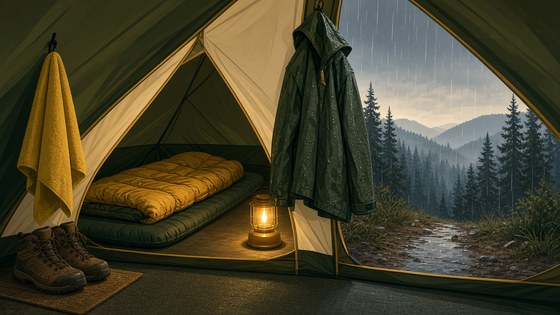
Keep a small towel by the door to wipe hands and faces before you crawl in. A microfibre camping towel dries quickly and packs into almost nothing, so it is worth keeping one in the kit box permanently.
Condensation is the other half of the problem. Wet weather plus warm breath equals drips on the inside of the fly by morning. Open the vents, even when it is cold, and leave a door zip slightly open at the top if the porch is sheltered. It feels backwards, but a sealed tent is usually the wettest one.
Your sleeping kit needs a barrier too. An insulated pad lifts you off cold, damp ground, and our round-up of the best sleeping pads for camping covers R-value, which matters even more when the ground is cold and wet. Pack the sleeping bag in a bin liner or a waterproof dry bag so it arrives dry, and keep it away from the tent walls.
If the evening turns cold as well as wet, our tips on how to stay warm while camping at night cover layering, warm drinks and the hot water bottle trick. A head torch helps more than you might think here. Hunting for a peg in the dark with your phone in one wet hand is miserable, so it is worth checking our headlamp picks before the trip.
Safety: never cook inside the inner tent, and only use a stove in the porch if the manufacturer says it is designed for that, with the door fully open. Stoves produce carbon monoxide, which you cannot see or smell.
Packing a wet tent away
Sometimes it rains on the last morning too. In my opinion this is the part people get most wrong, not the pitching.
- Pack the inner first, from inside the shelter of the fly, and put it in its own bag so it stays as dry as possible.
- Shake the fly hard, roll it loosely and bag it separately.
- Wipe or knock mud off the pegs before they go back in their pouch.
Then the important bit. Dry the tent within a day or two of getting home. Hang it in a garage, over the banisters, or pitch it in the garden on the next dry afternoon. A tent left damp in its bag can grow mildew within days, and that smell does not really go away.
Add the footprint, a towel and a couple of bin liners to your car camping checklist so they are always in the boot. Rain is not the problem. Getting caught without a plan for it is.