Disclosure: Some links on this page are affiliate links. If you buy through them, we may earn a small commission at no extra cost to you. See our affiliate disclosure for details.
Halfway up a long climb, the bottle is empty and the stream beside the path looks perfect. Cold, clear, tumbling over rocks. It is still a gamble. Sheep graze upstream, and you will not know what else is up there until your stomach tells you.
The best water filters for hiking make that stream safe to drink in a minute or two, weigh less than a phone and pack into a hip belt pocket. Most use hollow fibre membranes that strain out bacteria and protozoa. The real choice is how you want to use one: squeezed, sipped from a bottle, or hung from a tree.
The quick version: the Sawyer Squeeze is the most flexible pick for most walkers and backpackers. The Katadyn BeFree is the easiest for day hikes because the filter lives in the bottle cap. If you camp with a group or want to filter a pile of water with no effort, a Platypus GravityWorks 4 L system does the work while you pitch the tent.
Table of contents
What to look for in a hiking water filter
Filters are simple tools, but a few details decide if yours gets used or lives in a drawer.
- What it removes: hollow fibre filters with pores around 0.1 to 0.2 microns remove bacteria and protozoa such as giardia. They do not reliably stop viruses or chemicals, which matters more in some places than others.
- Flow rate: a slow filter turns every refill into a chore.
- How you clean it: some backflush with a syringe, others clean by shaking. Easy cleaning keeps flow fast over a long trip.
- Fit with your bottles: many squeeze filters screw onto standard 28mm bottle threads, which means a cheap smartwater style bottle becomes part of the system.
- Weight and bulk: anything under about 100g barely registers in a pack. Gravity systems weigh more but serve several people.

The best water filters for hiking
| Filter | Best for | Key detail (maker’s figures) |
|---|---|---|
| Sawyer Squeeze | Most hikers and backpackers | 0.1 micron hollow fibre, squeeze, inline or gravity use |
| Katadyn BeFree | Day hikes and trail runs | Filter in the cap of a soft flask, up to 2 litres per minute |
| Platypus GravityWorks 4 L | Groups and camp | 0.2 micron, hands-free, up to 1.75 litres per minute |
Sawyer Squeeze: best all-rounder
This is the filter I would hand to most people. You fill a soft pouch from the stream, screw the Squeeze onto it and press clean water into a bottle or your mouth. It also threads onto standard bottles or sits inline on a hydration hose. Sawyer lists the membrane at 0.1 micron.
The included syringe lets you backflush it when flow slows, and you will need to, especially on silty water. The pouches are the weak link. They can split at the seams over time, so plenty of hikers swap them for a sturdier bottle. In my opinion that small change makes it close to perfect. Check the current kit contents on the Sawyer Squeeze on Amazon.
Katadyn BeFree: best for day hikes
The BeFree is a soft flask with the filter built into the cap. Dip it in the stream, screw the lid on and drink straight through it. Katadyn quotes a flow of up to 2 litres per minute when the filter is clean, and cleaning is just a vigorous swirl in water, no syringe needed.
Best for: day walks, trail runs and anyone who wants filtering to feel like drinking from a normal bottle. Skip if: you need to fill a big cooking pot at camp, because squeezing a 1 litre flask into a pan gets old quickly. Have a look at the Katadyn BeFree on Amazon.
Platypus GravityWorks 4 L: best for groups and camp
Fill the dirty bag, hang it from a branch, and gravity pushes water through the filter into a clean bag below. Platypus quotes up to 1.75 litres per minute with a 0.2 micron hollow fibre filter. You can pitch the tent while it fills.
It is heavier and bulkier than the other two, and you need something to hang it from (a tree, a trekking pole, a car roof rack). For two or more people, or a basecamp where you are cooking and washing up, it makes everything calmer. See the Platypus GravityWorks on Amazon.
Filtering water safely on the trail
A filter only works as well as the water you feed it.
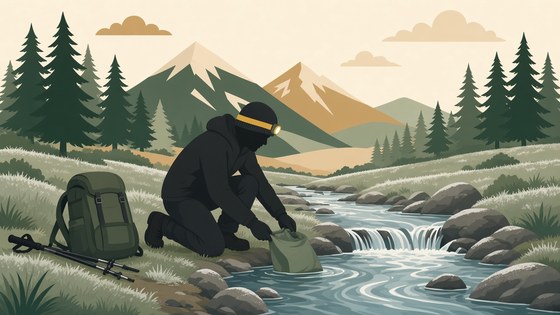
- Collect from moving water where you can, upstream of paths, campsites and grazing animals.
- Let silty water settle in a pot first, or pre-filter through a bandana, so the membrane does not clog.
- Keep dirty and clean bottles separate. A drip from the dirty side on the clean drinking spout undoes the whole job.
- Where viruses are a concern, such as water near towns or heavy human use, boil it or add chemical treatment as well. A rolling boil on one of the camping stoves we like covers it, and a camping kettle makes that easier at a pitch.
- Filters do nothing for chemical pollution, so avoid water near mines, farm run-off or roads.
Looking after your filter
Hollow fibre filters have one serious enemy: freezing. Water trapped inside expands and can crack the fibres without any visible sign, and then the filter quietly lets bugs through. On cold nights, keep it in a zip bag inside your sleeping bag, the same trick our guide on how to stay warm while camping suggests for gas canisters and tomorrow’s socks.
Backflush or shake it clean after each trip, let it dry with the caps off. If you suspect it has frozen or been crushed, replace it. A new filter costs far less than a ruined holiday.
One small aside. Write “dirty” on one bottle with a marker pen. It sounds fussy until you are sorting bottles by headlamp in the dark.
Filter, boil or tablets?
Each has a place. Filters are fast and leave water tasting of nothing. Boiling kills everything biological but costs fuel and time. Tablets weigh almost nothing and handle viruses, but most need a wait before you drink.
For most UK and European hill walking, a good filter plus a few tablets as backup covers you. If you are heading out for a weekend by car, add the filter to your car camping checklist anyway.
Get the filter habit right and water stops being something you carry in fear of running out. It becomes something you pick up along the way.