Disclosure: Some links on this page are affiliate links. If you buy through them, we may earn a small commission at no extra cost to you. See our affiliate disclosure for details.
Frost on the truck window. Coffee going cold. A ridge of oaks that looked empty until something flicked an ear in the brush. That is when cheap theatre binoculars fail you, and when a sensible pair starts earning space on a chest harness.
If you want the short answer on the best hunting binoculars for beginners, start with a waterproof 8×42 for most woodland and deer scouting. Move to 10×42 only when you glass open fields or longer cuts and can keep the image steady. Field of view, eye relief for glasses, honest glass quality, waterproofing, and weight matter more than a glossy hangtag.
Quick version: the Vortex Crossfire HD 8×42 is the tight-budget first pair. The Diamondback HD 8×42 is the all-round step up most beginners grow into. The Nikon Monarch M5 8×42 suits glasses wearers who want ED glass.
| Product | Best for | Key spec band | Skip if |
|---|---|---|---|
| Vortex Crossfire HD 8×42 | Tight-budget first hunting glass | ~393 ft FOV; ~17 mm eye relief; ~23.8 oz | You already want midrange sharpness |
| Vortex Diamondback HD 8×42 | All-round mid beginner woodland glass | ~393 ft FOV; ~17 mm eye relief; ~21.8 oz | Long open country every weekend (start 10x) |
| Nikon Monarch M5 8×42 | Glasses-friendly ED step-up | ~19.5 mm eye relief; ~22.2 oz; tighter FOV | Widest timber FOV is the priority |
For kit that shares early mornings outdoors, see the best headlamps for camping and hiking, the best camping tents, and the best camping stoves.
Table of contents
What the best hunting binoculars for beginners get right
“Best” for a first hunting optic is not the highest magnification on the shelf. It is the glass you raise often enough to catch movement before an animal melts into cover. Beginners usually glass from a stand, a quiet hardwood edge, or a short sit over a field corner. That work rewards a steady handheld image, a wide view for motion, and enough brightness for grey dawn and dusk.
Opinion, labelled as one: if you only buy one pair for woodland deer cover, buy an honest 8×42 first. Giant 12×50 “more power” tubes look tempting online and punish shaky hands in the woods.
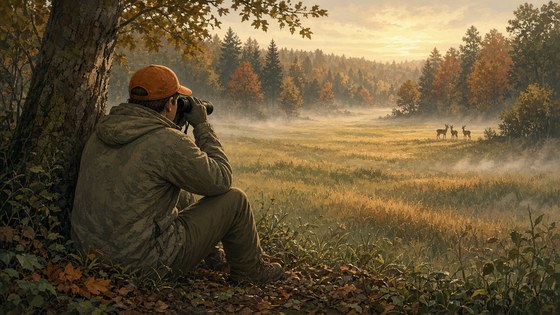
8x vs 10x for woods and deer country
The numbers on the hinge are magnification times objective diameter. An 8×42 shows subjects eight times larger through 42 mm front lenses.
Choose 8x when most of your glassing sits inside timber, thick brush, or treestands where animals appear and vanish fast. You get a wider field of view, a steadier picture, and a larger exit pupil (about 5.25 mm on 8×42 versus 4.2 mm on 10×42), which feels brighter when the light drops.
Choose 10x when you sit field edges, powerline cuts, or open country where you regularly judge animals past a couple of hundred metres. The trade is a narrower view and more handshake unless you brace on a knee, pack, or stick.
Objective size, field of view, and eye relief
Objective size is light-gathering potential. 42 mm is the beginner sweet spot: bright enough for dawn and dusk without the bulk of 50 mm tubes. 32 mm saves weight for summer scouting but gives up light.
Field of view is how wide a strip of woods you see at 1,000 yards. Wider helps you pick up movement and track a walking deer. Compare it when two 8x42s are otherwise close.
Eye relief matters if you wear glasses. Look for roughly 17 mm or more and twist-up eyecups you can leave down. Short eye relief clips the view into a tunnel.
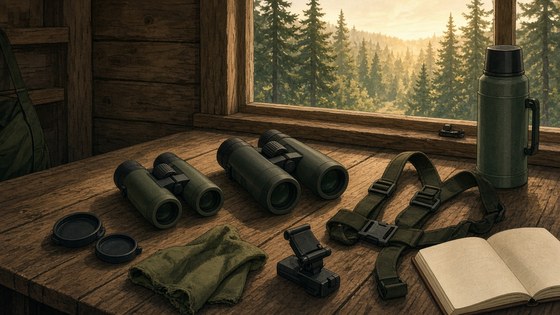
Glass, waterproofing, and weight
Fully multi-coated lenses are table stakes. Phase and dielectric coatings improve contrast. ED glass reduces colour fringing on high-contrast edges such as a backlit ridge, but a well-built non-ED pair can still beat a poorly built bargain. Focus-wheel feel and grey-morning image quality matter more than the word “HD” on the hinge.
Hunting binoculars should be waterproof and gas-purged so they do not fog inside when you move from cold truck air into humid woods. Most 8×42 pairs weigh around 600 to 740 g, which sounds light until it hangs on a thin strap for six hours. A chest harness spreads the load and keeps the glass quiet.
Safety and local rules
Never look at the sun through binoculars or any optic. Permanent eye damage is a real failure mode, including a quick glance at a sunrise over a ridge.
Know your local hunting laws, seasons, and land access rules before you go. Binoculars help you look carefully and identify honestly. They do not replace judgement.
Three beginner binoculars worth browsing
These models keep showing up in beginner hunting roundups. Check current field of view, eye relief, and weight on the listing you actually buy.
Entry value: Vortex Crossfire HD 8×42
The frequent first real hunting binocular when the budget is tight. Current specs sit near 393 ft field of view, 17 mm eye relief, and about 23.8 oz, and many kits include a harness. Not the sharpest glass, but a waterproof woodland on-ramp. Browse: Vortex Crossfire HD 8×42 on Amazon.
All-round step up: Vortex Diamondback HD 8×42
The pair many hunting forums point at for a first serious harness optic: around 393 ft field of view, 17 mm eye relief, and roughly 21.8 oz. The warranty reputation matters for gear that lives on tailgates.
Best for: deer and woodland hunters who want one 8×42 for years. Skip if: you glass long open country every weekend and prefer 10x from day one. Worth a look: Vortex Diamondback HD 8×42 on Amazon.
Glasses-friendly ED: Nikon Monarch M5 8×42
The Monarch M5 brings ED glass, dielectric prisms, and long eye relief (about 19.5 mm), at roughly 22.2 oz. Its field of view is tighter than the Vortex pair, so you trade width for colour control and comfort with specs on. Confirm the regional model name. Search listings: Nikon Monarch M5 8×42 on Amazon.
Quick FAQ
Are 10×42 binoculars too much for a beginner?
Not if your hunting is mostly open country and you brace well. For mixed woodland deer work, 8×42 is usually the calmer first buy.
Do I need ED glass?
Nice to have, not mandatory on day one. A solid fully multi-coated 8×42 with a good warranty beats a fragile bargain you are afraid to take into rain.
Value is not the loudest magnification number. It is the pair you still raise at 06:10 when the coffee is gone and the ridge looks empty.





Leave a Reply